September 21, 2016 11:38 am
BY MELISSA BURNS
Test anxiety is something every student should cope with. Nervous condition can prevent you from answering all questions correctly. To determine whether you have a spooky first exam syndrome, refer to this list of symptoms:
- increased heart rate
- digestive problems (e.g., nausea, diarrhea, etc.)
- jittery feelings
- sweating
- shaking
- shallow breathing
Even if you experience all of these factors, there is no need to panic. Many ways to minimize test anxiety exists. On the whole, student has to come up with a clear study plan/schedule, have enough rest, and discover healthy ways to handle stress. However, the main goal is to get rid of the source of your anxiety.
Think about what scares you most of all. Perhaps, you are afraid of failing or performing badly. And that’s OK. There are some useful tips to relax your subconscious mind and perceive the test easier.
- Decide on a study plan and revision timetable
Begin with planning. That’s the key success factor of any professional manager. You may wonder, but it is even more important to decide on your breaks than on the working hours. According to the research by the Anxiety and Depression Association of America, 20-30 minute spells work best, because student’s concentration is higher. Brief but frequent breaks are the clue. It is also better to mix the disciplines. Here is an example of such timetable:
- 8.30-9.00 Course 1
- Break 7 mins
- 07-10.00 Course 2
- Break 7 mins
- 07-10.45 Course 2
- Break 10 mins
- 55-11.40 Course 3
And so on.
- Put away all sources of distraction
Forget about your phone, social networks, favorite games, and other factors that can distract you from your mission. It is better to switch everything to the silent mode. By the way, some final homework assignments may also distract you from the main material. Teachers should not assign essays or math problems day before your exam. Thus, we recommend trying easy writing service to solve this problem.
- Eat and drink more
Don’t be afraid that you can gain some extra weight. Although grown-up human brain weighs about 1.4 kilograms on the average (2% of total body weight), it demands 20 percent of the resting metabolic rate (RMR). In other words, we really loose certain amount of calories when thinking really hard. Memorizing things belongs to this category. So, eat whenever you feel hungry. Avoid fast food and alcohol beverages. It would work much better if you choose green tea.
- It’s okay to ask for help
There is no need to be too proud to ask for help. We are not talking about your parents and peers only. After all, they are not experts in education. Unfortunately, they cannot teach you in a proper way. You should not hesitate to ask your teacher t explain some topics. He or she is there to assist you in all academic issues until the day of exam comes.
- Find some time for physical activity
We are not talking about meeting with a personal trainer for heavy exercises in the gym. We rather mean no more than 30 minutes of simple aerobic activity like running, squatting, or jumping. You can simply have a walk around your favorite places.
Melissa Burns graduated from the faculty of Journalism of Iowa State University in 2008. Nowadays she is an entrepreneur and independent journalist. Her sphere of interests includes startups, information technologies and how these ones may be implemented.
September 20, 2016 7:53 am
BY LALE BYQUIST
Being a final-year student, you start thinking about your future career, and it’s more likely you try to shift the educational process and career growth as it’s important to create a good portfolio to get a great job position after the graduation. Obviously, to succeed in both processes, you need to be highly productive, and it’s not an easy thing to do.
If you want to be A+ student who manages to work and study, learn more about eight actionable ways to burst productivity:
- Prepare Assignments in Advance
If you have some college task that is not urgent, don’t wait until the deadline comes to write it. The earlier you complete it, the more time you have to spend on your career development. None loves being pressed for time, so never skip doing assignments in advance.
- Learn on the Move
Most senior students have a big load of tasks, and it’s important to read, write, revise a lot. To save time, you can learn on the move: read books, write outlines, pass online courses, revise materials, listen to podcasts on your mobile gadget once you have time to do it. For example, use your spare time the right way while waiting in a queue.
- Ask for Help
Every person gets stuck on completing some task from time to time. If you don’t know how to do something, ask for help. It’s better to learn how to ask for assistance in order to avoid making the same mistakes than putting much effort to do everything on your own. Moreover, it’s important to offer help if you see that someone needs it.
- Stop Using Social Media
Let’s be real: all modern students keep in touch with their friends using social media. Although we love writing SMS, it takes a considerable amount of time to text them, and it takes extra time to check your phone for receiving a reply. If you need to discuss something, call your friend, and never use social media if you don’t have free time.
- Earn Money Online
Most modern professions give an opportunity to find out ways how to create your portfolio and earn money online. Studying at college or university, you need to spend a considerable amount of time learning, and if you have a possibility to work online, never lose it.
- Cope with Stress
Shifting work and education can cause stress, and it’s crucial for you to learn how to cope with it. Stressful factors can be everywhere and they affect your well-being which means reducing your productivity. Thus, you’d better prevent stress, and keep being a happy person.
- Make the Most Out of Your Breaks
Productive people know how to manage time the right way. No matter why you have taken a break, use it with a benefit. For example, you can revise college material while having a lunch, read useful articles while relaxing after a hard working day, or simply call clients while being at college. Learn how to save time, and your productivity will increase with ease.
- Stay Inspired
There is no better way to boost productivity than stay inspired. If you have energy and desire to complete something, you can save time and efforts on making it. Thus, you’d better stay inspired in college life as it might help you deal with different tasks.
The Wrap-Up
Productivity is a key to success when it comes to being a happy person. It goes without saying that having good time management skills can help you get more things done without sacrificing your personal life. It’s highly important for senior students who want to be good at college and work.
If you have your actionable tips on productivity, don’t hesitate to share them!
About Lale Byquist
Lale Byquist is a media communications student at Trinity University, Texas. Lale created PresentationSkills.me site as she had faced the fear of public speaking. She is sharing tips and tricks on overcoming this fear, and you’re welcome to contact her on Facebook or Twitter.
September 19, 2016 7:40 am
By Samantha Brannon
A man is a success if he gets up in the morning and gets to bed at night, and in between, he does what he wants to do.” Bob Dylan
We knew them in high school. We knew them in college. Those students who were really smart and who really put in the hours studying. Several years later, however, we find them still working hard, and yet their careers and other parts of their lives just don’t seem to be “taking off.” How does that happen? Well, it happens because there is more to professional and personal success that just being smart and hardworking.
Defining Success
The world tends to see success through a very narrow perspective. Most often, it means having lots of income, so that new shiny things are affordable – the big house, the new car every two years, that country club membership, etc. But success has a much broader definition. It includes great relationships, doing what we love, helping to make this world a better place, and to and being happy with who we are and with what we are yet to become. Within this broader context, then, a lot of smart and hardworking people are not successful. Here are the things that keep them from that success.
- Not Learning to Operate Outside of the Sandbox
The school is a sandbox. We learn to follow the instructions of our teachers; we practice getting along with others in a contrived environment; we learn that working hard will get us good grades and lots of praise; we learn how to memorize and take tests. Life, unfortunately, is not a sandbox. And if we continue to exist in that sandbox, we are always waiting for others to tell us what to do, what and how to learn, and how to be successful.
- Not Reaching Out for New Connections
Lots of smart, hardworking people tend to move in the same circles – that’s where they are comfortable. They continue relationships with like-minded friends from high school or college; they find a niche of like-minded people in their workplace. They stick with these relationships, because they are safe and because they reinforce the values, principles, and inbred standards of “work and play.” Doing this narrows a person’s perspective so much that s/he does not see the almost limitless possibilities within the world.
- Not Taking Risks
Smart, hardworking people often choose security over freedom. There’s a lot to be said about security, of course. But here’s the thing: That security can become so important that we can’t force ourselves to take the risks that will move us up in that hierarchy, and we live what Thoreau called, “lives of quiet desperation.” We are trapped in our bubbles, and we then come to the end of lives wondering what might have been. Taking those first steps are scary, but just one can lead to the next and the next. Thinking up great new ideas has its place, but when there is no follow through, they are, in the end, just daydreams.
- Not Living in the Now
We read a lot about “living in the now,” as philosophers like Eckhart Tolle advise. While many focus on the fact that they should not worry about their futures, this also means not living in the past. One of the most important principles of success is that the past is a great teacher, but it is not a predictor of success today. Every day, we must wake up thinking what ca I accomplish today? What new idea can I work on today? How can I impact others and the world around me today?
- Insisting Upon Perfectionism
Smart, hardworking people often insist upon perfection. This is a holdover from the sandbox of school. They needed that 100% on a test; they needed that perfect “A” paper. And when they get into the world, that habit continues. The problem with perfectionism is that we don’t move forward and are seen by others. Perfectionists cannot delegate and cannot let their team members make mistakes and grow. They micro-manage everything.
- Not Knowing When to Ask for Help
This may come from a lingering sandbox ego. Smart people achieve success through hard work – they always have. So, if things are not working out, then it just means they have to work harder. And so they do. And in the end, when they do not ask for that help, they often fail. And because failure is intolerable, they feel utterly destroyed. People who have experienced failure in the sandbox can tolerate it, and they learn to rise above failure on when it is critical for their success. Never failing at something means we haven’t tried new things – how boring and unfulfilling is that?
The High School Reunion Brings it All Full Circle
Last year, I went to my high school reunion – you know – that event at which everyone tries to demonstrate how successful they have become. The kid who everyone thought would not amount to much now has his own successful business and in thriving in his passion for what he does. The kid you thought would set the world on fire has settled into a corporate position which sounds a bit dull. And me? I am neither rich nor am I settled into a secure job. On the other hand, I am pursuing my passion; I am taking chances and failing sometimes; I believe that what I do helps others, and I wake up each morning wondering what new challenges await that I can sink my teeth into. I’ll go out having enjoyed the ride, and that, to me, is a success.
About the Author:
Samantha Brannon is an entrepreneur and freelancer. She is also a co-founder and writing editor at Trustessay writing service. Samantha loves self-education and rock music.
September 16, 2016 7:57 am
BY SYLVIA KOHL
Contrary to a popular belief, it’s not only economists who have to learn all the ins and outs of money management. Being aware and responsible with your funds is the basis of financial success, and you should start learning all about this from a young age. This guide on how to manage money in college and overview of the tools that can help you will help you make wise financial decisions from the very start of your independent life.
How to Manage Money in College: Step-by-Step
There are a variety of guides on student money management and they usually boil down to:
- Create a budget.
- Use student privileges such as special discounts.
- Apply for scholarships or grants if possible.
- Get a part-time job to pay for extra expenses.
- Plan large expenses in advance.
- Look for discounts and special offers to help you save money.
- Pay your bills on time to avoid the accumulation of debts and paying extra charges.
The great news for those who learn how to manage money in college today is that there are a variety of solutions to help you with all the tasks mentioned above. The most effective of them are:
Mint for Budgeting
Creating a budget is essential for a student as it allows you to manage your funds most effectively. The question is how do you do this?
Mint is an app that makes budgeting truly easy. You just need to connect it to your bank and it will provide you with effective prompts on how to create an efficient budget. This app is considered to be one of the best among its class and it’s one of the most secure solutions available. It uses the same security as banks and will alert you to any unusual charges.
Due for Business Payments Management
If you are like the thousands of students who start making extra money by building a business right from college, Due is going to be your best helper when it comes to managing online payments. This solution is extra efficient and has the transaction fee of only 2.7%, both for domestic and international credit cards.
Due allows you to keep track of all invoices and pending payments, which is a huge help for freelancers. The solution is universally effective for any kind of business. It can help you avoid using complex accounting and billing software.
Shopkick for Smart Shopping
No ‘how to manage money in college’ guide can go without the advice to use any advantage to get the best deal on every product. Shopkick is the app that allows you to do this. It will help you find the best deals from a variety of stores as well as earn points when buying. The points can be transformed to gift cards that will save you money in the future.
RetailMeNot for Coupons
RetailMeNot is another money-saving app that provides you with the best coupons for any kind of store, including popular restaurants. Finding the deals is easy and you just need to show the coupon on your smartphone screen when paying to get the desired discount. You can discover coupons on the go as the app will provide you with alerts on deals in your area.
Sylvia Kohl is an IT teacher with more than 7 years of professional experience. Her main spheres of interest are e-education and beta-testing. This writer chose news about the increasing role of IT usage in colleges and schools as the most common topic for her articles.
September 15, 2016 8:14 am
By Patrick Cole
It can be intimidating preparing your resume after college, particularly if you’ve solely focused on going to school and don’t have a great deal of work experience. What the heck are you supposed to put on your resume? How can you make yourself look like somebody that people will actually want to hire?
You’ll be glad to hear, it is actually possible. How do you do that? Read on.
You only need a page and a goal
The first thing to realize is that you only need to fill one page. The best resumes don’t go past this. This means that it can often be easier to make a good, cohesive and interesting resume when you’re fresh out of college than when you’ve been working for a while.
Just make sure that it’s precise. Don’t put vague comments about wanting ‘a well-paying entry level position’. Everybody wants that and putting it in is, therefore, wasting valuable seconds you’ve got to impress your audience, and as you only get a few, that’s not a good idea.
There are two forms of resumes
The more traditional graduate format is to have the objective at the top and then to follow it with your educational background and the relevant coursework that you’ve done. Yes, that’s right, it’s perfectly alright to include course work on your resume. It might not be the same as hands-on experience, but it is still relevant information for an employer to know.
From there you go on to your experience and your skills.
The other way that you can design your resume is to start with your training and your skills at the top, as these are the most relevant in many ways for many employers, which is followed by education, experience and finally your employment history (if you’ve got any).
List your school, your degree, the year you completed it and honors
What about your GPA? You only want to include that if it’s high. If it isn’t particularly splendid, you should probably leave it out. Sure, some HR people will read between the lines that your GPA wasn’t particularly splendid, but then that’s better than having all of them read it, don’t you think?
So how high should it be before you can include it? There is some disagreement about that. Some say that you can already put it in at a 3.0. Others disagree and think you should only include it if it is 3.8 or higher. And when there is disagreement, you’re going to have with your gut. Here is some more information about how long your GPA should be on your resume for.
Make sure that the courses you include on your resume are relevant to the position you’re applying for!
Cast what work experience you have in the best light
Worked as a burger flipper one summer? That can still be a useful thing to include on your resume, particularly if you can cast it the right way. Maybe you get promoted quickly, maybe you learned some very valuable life skills, or maybe it’s that you really appreciated how a large team can work together.
If you can recast your simple job in this light and make it clear that you learned things that are relevant to what you were doing, or if you can get the attention of the HR person so that they sit up and take note, then it can be useful to include. Sure, it might not add that much weight on its own, but it’s the whole picture that matters and a well-described menial job can add real color to your story.
Don’t neglect your extra-curricular activities
Again, these might not be enough on their own to convince anybody to have you over for an interview, but that’s not the point. The point is that it becomes part of the marketing package that is your resume. If you were part of the chess club, learned to program, or acted in the theater, that can be worth including for some jobs, as just because you didn’t get paid, doesn’t mean you didn’t learn anything.
Similarly, if you volunteered, counseled or did social outreach, including those can make it clear to employers that you’ve actually got some of the soft skills that they are often looking for in new graduates.
Don’t overload your resume
‘Great’, some of you are now thinking, ‘I’m going to throw everything and the kitchen sink onto that page now!’ Don’t do that. It is important to realize that you don’t just need words on your resume. You also need white space.
For that reason, make certain that your resume is easy to read, has bullet points, is correctly laid out and has clearly defined sections so that people can easily find what they’re looking for. In that way, your audience will find it easier to digest, which will make them more favorably disposed towards you.
Don’t neglect the little things
When you’ve written up your resume go over it and go over it again. An extra space, a strange line jump, or a grammar mistake can cost you an interview. That sounds harsh, but it’s true. You have to remember that most HR people are going through hundreds of resumes for positions.
For that reason, many will use any excuse to whittle down a pile. A sloppy layout and poor grammar is exactly that kind of an excuse.
Yes, that sounds like a lot to digest. Don’t worry, though, there are many people out there to help you. You can keep reading these kinds of posts, or consider using a service. There are numbers expert websites out there to give you a helping hand and make certain your resume sticks out head and shoulder above the competition.
After that, you’ll just have to kill it at the interview. But that’s another story.
About the author: Patrick Cole is a passionate writer and contributor to several websites. Loves to write about education and self-realization. You can connect with him via Twitter
September 14, 2016 8:18 am
Report finds initiative fatigue and a lack of accountability, among other obstacles, are preventing colleges from improving student outcomes.
By
Carl Straumsheim, InsideHigher Education
Academic leaders say all the other colleges and universities out there are responsible for why higher education is delivering less value than it did 10 years ago, an upcoming report found. Their own institutions, they say, are doing even better than before.
The report, based on a survey of 218 high-ranking administrators — including presidents, vice presidents and provosts — at private and public two- and four-year institutions, explores the barriers preventing colleges from improving student outcomes. The report, which will be published Sept. 29, suggests many colleges are struggling with a “bystander effect”: everyone is responsible for improving student outcomes, so no one takes ownership of it.
Eduventures, the Boston-based research and consulting firm behind the report, gave Inside Higher Ed an advance look at the findings. James Wiley, a principal analyst at the firm who wrote the report, said the survey responses suggest a “misalignment” between how college leaders view the work taking place at their own institutions compared to higher education more broadly.
“The overarching takeaway is that it’s very unclear what ‘student outcomes’ means,” Wiley said in an interview. Without a clear sense of which metrics they should be looking at to determine how students are performing, colleges are creating uncertainty around what technology could benefit students and who should be responsible for managing that work, he said.
The report identifies five obstacles hindering colleges from improving student outcomes, ranging from a lack of focus on teaching quality to organizational barriers. But the attitudes expressed by college leaders also raise questions about whether they feel the push to improve higher education should start on their own campuses.
About half of respondents said the value offered by their own institutions is much or somewhat higher than a decade ago. Another quarter said it is roughly the same. Asked to rate higher education as a whole, about three-quarters of respondents said the value has decreased or remained the same.
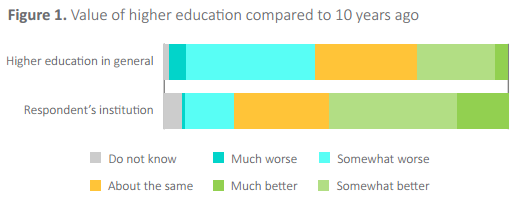
The split in some ways resembles the difference between the disapproval voters feel about Congress versus the high marks they give their own representative, Wiley said.
The same finger-pointing emerges when looking at who college leaders say should be most directly responsible for student outcomes. The No. 1 answer, selected by more than 40 percent of respondents: everyone. Less than a quarter of respondents each picked a more specific answer, such as a provost or a vice president of student success.
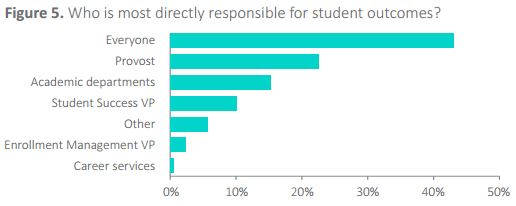
Wiley said he was surprised that nearly half of the senior academic leaders surveyed couldn’t point to a single individual or office in charge of improving student outcomes. “If you don’t own it, then who does?” he said.
The lack of clearly defined leadership roles may stem from the fact that many academic leaders feel their institutions are stretched too thin. The top organizational barrier preventing colleges from improving student outcomes, according to 63 percent of respondents, is initiative fatigue — that they simply have too many pilots and projects going on to focus. Budget constraints placed second on the list, with slightly less than half of respondents naming it their top barrier.
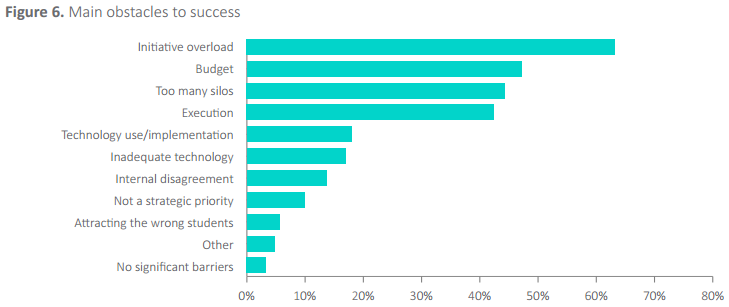
“What I’m sensing is a bit of a vacuum,” Wiley said. “Leaders are pulled in all directions, and if there’s no real ownership or space to do anything, then what fills that void?”
Gunnar Counselman, CEO of the ed-tech company Fidelis, who worked with Eduventures on the report, said he often hears about initiative fatigue from his customers. The company supplies learning relationship management software to colleges.
“Higher education is drowning in initiatives right now,” Counselman said in an interview. “What’s happened in the last 10-12 years is that higher ed has recognized that what got them here is not going to get them there. They’ve recognized that they’re going to have to change, and as a result of that … they’ve put a dozen initiatives in the water.”
College leaders are also uncertain about what kind of technology they need to invest in to improve student outcomes, the survey found. A majority of respondents (56 percent) said their top priority for investing in technology is to boost admissions and enrollment, compared to about one-third (37 percent) who picked improving student outcomes.
September 13, 2016 7:43 am
By Melissa Burns
Being a student is challenging at times, but with the right tools, you’ll be able to succeed in your studies. You’ll also have enough time to enjoy an active social life. You might even add some small business to your schedule in order to get a good start in life before leaving college. Relying on the best productivity software for students will allow you to achieve the best results in everything you do.
The students of today have a great selection of digital tools that can help them with any task, from project organization to essay writing. The most efficient of them are:
Asana
Asana is a type of collaboration software aimed to help teams manage their workflows more efficiently. It’s completely indispensable for group projects on any subject. The app offers attractive design and extremely high functionality.
It enables you to create and manage projects with any number of members, providing you with a responsive and fast interactive environment. Asana is one of the best productivity software solutions for students because it helps every member of the team do their best. It also gives you a chance to see where the sum of your efforts is going in ‘real time’.
Panorama Necto
Panorama software is an intelligence tool perfect for processing analytics and developing insights that will move your business forward. If you are assigned with developing a business plan, there is no better tool for you than Necto.
This software provides you with extremely efficient dashboards and infographics. They are easy to both use and understand. You can use them to assess the level of performance and see which areas of your project require improvement.
Panorama software is extremely versatile, so students can use it in a variety of ways in order to increase their overall productivity.
Dragon NaturallySpeaking
Unlike many other kinds of best productivity software for students, this solution isn’t free. However, it’s the most efficient dictation software that currently exists. It can be a huge help for a student who is always hard pressed on time, because it makes typing redundant.
Just imagine being able to dictate not only your notes but essays, emails, and any other messages. It also allows you to navigate the Web and perform some of the computer tasks through voice management.
Dragon NaturallySpeaking is a fantastic helper for those who struggle with controlling computer by hand or just want to save more time. The price bites, and the software is only available for Windows now, but the benefits it offers are worth the investment.
Zotero
Zotero is a must-have tool for students and researchers of any kind because it allows you to manage, track, and share citations online. It’s a web browser plugin that would work with Mozilla Firefox, Apple Safari, and Google Chrome. You can integrate the app into your word processing software to make introducing online citations into your research a simple task.
The library of citation styles supported by Zotero is extensive, so you’ll be covered for almost any project imaginable. The extreme flexibility and simplicity make it a great help for any student.
Stayfocusd
This is the best productivity software for students who have an issue with distractions. It’s a very common problem today, and Stayfocusd will ensure that your grades don’t suffer from lack of discipline.
This URL blocker will cut off all time-wasting websites and services to keep you focused on the task. The app is highly customizable, so you can adjust it to your personal schedule to ensure the top level of personal productivity.
Best Productivity Software to Use in 2017
Each of these tools can help you achieve better results in class and life as a whole. Use these solutions to manage various aspects of your college life and work out your personal winner scheme of digital task management.
Melissa Burns graduated from the faculty of Journalism of Iowa State University in 2008. Nowadays she is an entrepreneur and independent journalist. Her sphere of interests includes startups, information technologies and how these ones may be implemented.
September 12, 2016 7:48 am
September 9, 2016 8:03 am
By Sylvia Kohl
Modern fashionable devices have replaced many outdated things that saved our academic life in the past. For example, when was the last time someone used a sliding ruler? Or how many of your classmates use a physical day planner instead of a calendar app on their phone? And yet, there are many things that may seem obsolete to some, but could actually help you get ahead in the modern era.
The point is that every student still can use things like television, radio, lecture notes done in hand, and other outdated approaches to succeed with both educational performance and after-class activities.
- Television & CRT Televisions
With Hulu, Netflix, and Amazon Prime rising to prominence, it’s becoming less common for students to watch traditional network, dish, or cable TV. However, the value of television is underestimated by many young people. As the University of Michigan Health System reports, children still spend about 28 hours per week watching television. This way, they unintentionally learn different narrative structures, improve their reading speed, get in touch with world’s cultures, and more. One more important benefit of this activity is a non-fiction educational viewing. A great share of programming is developed to achieve teaching goals. “Sesame Street” might be a good example. We can find a lot of programs dedicated to such disciplines as:
- History
- Astronomy
- Biology
- Mathematics
- Humanities
- Mechanics
As for the CRT televisions, they might be a better choice for students thanks to their low price, ability to handle multiple resolutions, and display color more accurately. If a student does not want to use CRT television or plasma to watch TV, he or she can apply online tools like Dish Network or DirecTV.
- Handwritten notes
Thanks to laptops and tablets, it seems like there is no need to waste your time on hand-made lecture notes anymore. There is always an opportunity for each student to take pictures of the slides or other materials with the help of even the most primitive smartphone or laptop. It is faster. It may look more comfortable. At the same time, you will spend the same time in class taking notes.
Even though typing your notes may seem like it has an advantage, writing them out is still recommended. Psychologists say that hand-written notes stimulate the critical thinking and memory-making parts of students’ brains. This is because once you’ve seen the text and put it on your paper, you have repeated it twice. This piece of information is much more likely to remain in your memory for a while.
- Local storage
Most advanced computer users today prefer to store all necessary information on the web. I often hear students saying that you should save all data in the cloud. They really underestimate the value of the premise itself. The advantage of cloud is having access to the files with important lectures and assignments anywhere. In addition, the files are backed up accurately.
At the same time, there is no warranty that nothing will go wrong. You cannot be sure about external things as you have no control over them. It is better to make a copy of each important file on local storage. Internet connection may drop anytime, or could be spotty and slow depending on location. Viewing your files from the local storage does not require Internet usage. By the way, floppy discs are helpful for the same reason.
- Software and programs
In the age of rapid technological progress, we all have an idea of how to make the process of learning more fun. A lot of online educational tools and software may assist students in memorizing the material better. When it comes to choosing between old and new programs or software, simply compare old and new Windows. It’s like evaluating the benefits of watching television. Older versions of Windows are much more comfortable thanks to familiar navigation and interface. The only risk is a disappearing support for Windows 7 and XP. Students should not also ignore old good Linux in case they prefer to keep away from viruses.
- Portable media players
I still remember my cheap Korean T.Sonic with 8Gb of memory. It was awesome. Nothing could break it apart unlike a couple of my smartphones. Today, the portable media player is thought of as an obsolete thing. Windows and Android phones all possess a built-in Zune, so many students may wonder why in the world they may need an old buddy. Those who use media players report their capacity and ability to be connected to a TV. In addition, battery consumption is far less than modern devices have. You’ll be able to listen to the favorite music or lecture notes at any time and everywhere.
Sylvia Kohl is an IT teacher with more than 7 years of professional experience. Her main spheres of interest are e-education and beta-testing. This writer chose news about the increasing role of IT usage in colleges and schools as the most common topic for her articles.
September 8, 2016 6:15 am
Oksana Sbitneva
One of the most widespread problems students encounter immediately after going to college is, however mundane and boring it may sound, homesickness. Getting far away from one’s habitual environment, probably for the first time in one’s life, turns out to be a much harder and more complicated ordeal than most would-be students want to believe. Nevertheless, it is true, and everything that helps battle it is a godsend. So, what can you do to make your college dorm more homey? Let’s find out.
1. Turn Old Magazines into Wall Art
If you feel depressed by stark naked walls of your new room, a quick and dirty way to rectify this flaw is to go through your old magazines, cut out the pages that strike your fancy and attach them to the walls in as spectacular a fashion as you can manage. Without going to any great expense, it will immediately render your dorm a much more personalized and homey atmosphere.
2. Throw Pillows
Students are usually given a fair amount of freedom in how they want to decorate their dorm rooms – which means that in most cases the only opposition you will have to deal with is going to come from your roommate. Try to recruit them to your cause, then, and turn your room into something that will feel like home for the both of you. Throw pillows are a good way to start – they are relatively simple to make on your own, immediately lend the room a cozy feel and can be made to create any style you want.
3. Add Photos
Photos of your family, friends and loved ones are about as personal as one can get. Decorate your desk and walls around it with them, and you will immediately get a charge of energy whenever you glance at them while you are reading or studying for exams.
4. Get Comfortable
You will never feel at home anywhere where you are physically uncomfortable. So make sure you are comfortable wherever you go! Make special effort to customize your sleeping space so that it is a just right combination of hard and soft. Place a rug near the bed – stepping on it in the morning can make all the difference between an institutional feeling and that of your old home. Go to an expense of buying a chair in which it will be comfortable to sit, study and read – after all, it is exactly what you are supposed to be doing in college.
5. Buy a Plant
Add a little life to your dorm room by buying a plant of your choice and placing it in a conspicuous spot. It will add a touch of personality to the boring place and will give you something to take care of – an ideal way to get your mind off homesickness.
When all is said and done, it is your own choice whether to feel at home in your new dorm or get homesick. If you look into the future and are fascinated with your new station in life, nothing will be able to keep you down!
Bio:
Oksana is a student of English literature department and a freelance journalist. As a current student she is interested in trends in education and she would like to share her experience with community.