New Hope For Community College Transfers

Low-income students who transfer from community colleges to four-year colleges are less likely to get a degree than their wealthier peers, a new report shows. But in a sign of hope, their success varies dramatically by state and by college.“It means that demography is not destiny,” said Davis Jenkins, one of the report’s authors and a senior research associate at the Community College Research Center at Teachers College, Columbia University. “If we care about upward social mobility, then we need to pay attention to transfer students.”

Nationally, just 36 percent of low-income transfer students complete a B.A. compared with 44 percent of middle and upper income students.

For decades, the ability to earn a college degree has been determined largely by whether a student starts off poor. Most low-income students go to community college, so increasing the number who successfully transfer and get a bachelor’s degree could enable those low-income students to use higher education to get to the middle class.

Overall, only 14 percent of all students who entered a community college in 2007 transferred and then earned a four-year degree within six years, the report shows. (Some dropped out, some left college after earning their associate’s degree.) Among those who did transfer, on average 42 percent went on to get a bachelor’s degree within six years of starting at a community college.

Related: Underserved and overburdened, transfer students face an uphill battle to earn their degrees

Iowa also stood out as having one of the smallest gaps between rich and poor students who earned a bachelor’s degree – just one percentage point. Florida and Nebraska also had less disparity.

Meanwhile California, Illinois, Texas, New Jersey, Pennsylvania and Virginia had a higher-than-average percentage of transfer students who earned B.A.s, but they had a lower-than-average percentage of low-income students getting a four-year degree. It appears that at least some of these states achieved high overall rates because of the strong performance of higher-income students, the report’s authors conclude.

The report did not offer specifics on why some states and colleges were successful – that will be examined in a report planned for May – but the authors said that the states with good results had solid partnerships between community and four-year colleges. They also had simple ways to transfer credits and they paid special attention to transfer students, in the same way some colleges orient and support freshmen in their first year.

Related: Federal study finds 40 percent of transfer students get no credit

The academic and social preparation provided by community colleges was clearly important. But the researchers said that the approach taken by the four-year colleges was equally, if not more, significant and could increase chances of success, regardless of where the student had started.

Public colleges and universities were more successful in general than nonprofit private ones, and both did much better than for-profit colleges, which had an 8 percent average graduation rate. Jenkins called their results “scandalous.” Selective colleges did the best.

The report paints a hopeful picture of what is possible if public policy shifts, since 70 percent of those students who do transfer go to four-year public colleges.

“Seeing the enormous variation suggests that colleges can dramatically improve,” said Josh Wyner, vice president and executive director of the college excellence program at the Aspen Institute, a nonprofit think tank. “There is a huge potential to increase the number of students who attain a baccalaureate degree.”

The report, released Tuesday, was produced by the CCRC at Teachers College (The Hechinger Report is an independent unit based at Teachers College), the Aspen Institute College Excellence Program, and the National Student Clearinghouse Research Center, and was funded by Carnegie Corporation of New York and The Leona M. and Harry B. Helmsley Charitable Trust (which have also funded The Hechinger Report).

This story was produced by The Hechinger Report, a nonprofit, independent news organization focused on inequality and innovation in education. Read more about Higher Education.


How The Internet Can Get Students Engaged In College Writing

By Julie Petersen

 The Internet now provides an endless sea of information and opportunities for students. They are able to participate in better writing and more informed reading. And for many students, the Internet is providing solutions to many of their learning woes.

Not every student will turn out to be a professional writer. However, every student benefits from forming proper writing skills. They are imperative to success and future opportunities. And for many college students making it through the writing process can be a struggle.

There are various ways accessing the Internet can aid in engaging students in their writing. Many sources offer study guides and essay writing assistance. And others provide games, interactive learning challenges and supported reading information.

The more knowledge a student has, the better equipped they will be for success. And the World Wide Web is providing plenty of educational tools for support.


  1. Hippocampus

This video library is a great place for students to go when they need a reading or study break. College students can use the educational videos for research or to review information, as well as to begin plotting their assignment structure.


  1. Shmoop

Shmoop makes learning more fun with their literary activities. They will engage college students in various topics and also provide standardized test and study help. It’s a great source for any college student looking to spice up their study regime.


  1. Pinkmonkey

The Pinkmonkey site includes printable documents, study guides and digital libraries. It is currently the world’s largest free online library of literary summaries. And it is one of the best places for students to find inspiration and essay writing support.


  1. Essaymama

This professional writing service is composed of certified professionals. They can assist students with structure and punctuation or spelling advice. And they provide easy access to essay writing guides, free writing contests and a blog full of inspiration.


  1. Quill

Quill is a great way for students to practice their writing skills and for them to constantly review and improve their abilities. The site includes various grammar exercises and engaging writing activities for college aged students.


  1. Bookrags

The Bookrags site gives students access to over 6,000 guides, 22,000 essays and tons of other useful study materials. It’s an efficient place for research and a smart way to find examples that support or assist any writing issue.


  1. NovelGuide

This website allows users to read summaries or “cliffs note” type references of literary works. Students will be able to review synopsis and analytical notes as well as reports and videos to help study any piece of writing. The site in essential for any English lit course or essay writing assignment.


  1. Gutenberg

Gutenberg is an excellent site that allows users to access free reading material. Students and individuals can download over 46,000 eBooks (available in txt or epub format), and the easy to navigate database makes the process quick, informative and super helpful.


  1. Study.com

Whenever students are getting bored or find their minds wondering, they should turn to Study.com. The site offers various interesting educational and instructional videos that are provided by top-notch professional educators. Listen, watch and learn to create new inspiration and engagement in assignments.

No matter what type of student, or what class, everyone needs to be able to work on his or her writing abilities. Almost any profession today involves some form of writing. And college students must be able to maintain focus while properly practicing their skills.

The sites listed will help students to form better writing processes and to facilitate their own education. In such a digital world it’s important to use what technology is providing to increase success rates.

The Internet makes communication faster and easier and in turn creates a wonderful new world for college assignments. Students should feel more supported than ever before. And they should never be afraid to seek help. Try these ideas and take note as your writing skills are drastically enhanced.

Author’s bio:

Julie Petersen is a private English language tutor and a content marketing specialist. She is the author of AskPetersen.com (essay review blog), and a contributor to such websites as FreelanceWrite.About, Business.com, Teach.com, etc. Contact Julie on Linkedin.

Top Ten Higher Education Policy Issues For 2016

As higher education issues command more attention this year from presidential candidates on the campaign trail, governors and state legislators are also expected to address an array of public policy issues affecting students and institutions of higher education in the upcoming legislative sessions. This brief provides a synopsis of the higher education issues most likely to generate legislative activity in 2016.

Last year’s legislative outcomes, along with gubernatorial statements, newspaper articles, and economic projections, informed this ninth annual iteration of the Top Ten. While many of the topics listed are recurrent, state political, economic and policy realities remain dynamic, leading to a host of new challenges and opportunities for policymakers seeking to address these issues. Other items, such as student loan refinancing and debt management, reflect emerging concerns that could occupy more legislative agendas in the months and years ahead.

Authored by the Thomas L. Harnisch and Kati Lebioda

Colleges Revamp General Education Requirements

 By
Scott Jaschik, Inside Higher ED
 When colleges discuss general education reforms or announce curricular revamps, it’s common to hear professors talk of the need to replace “cafeteria-style” approaches. Distribution requirements, critics say, may assure that all students take a course or two in such broad fields as the humanities, the social sciences and the physical and biological sciences. But the requirements don’t necessarily encourage thoughtful integration of different fields of study — and many students simply look for the easiest options to check the requirements off. (Think “physics for poets.”)

But for all the talk about moving past distribution requirements, it turns out that they are alive and well, but with twists that deal with some of the criticisms.

That is one of the key findings of a survey — released today by the Association of American Colleges and Universities — of its members on issues such as general education, learning outcomes and teaching approaches. The results being released today are the second from a survey completed by provosts or chief academic officers at 325 AAC&U member colleges and universities.

Other key findings relate to a growing majority of colleges having intended learning goals or outcomes for all students, and some skepticism about whether faculty members are using technology in the most effective ways.

Distribution Requirements

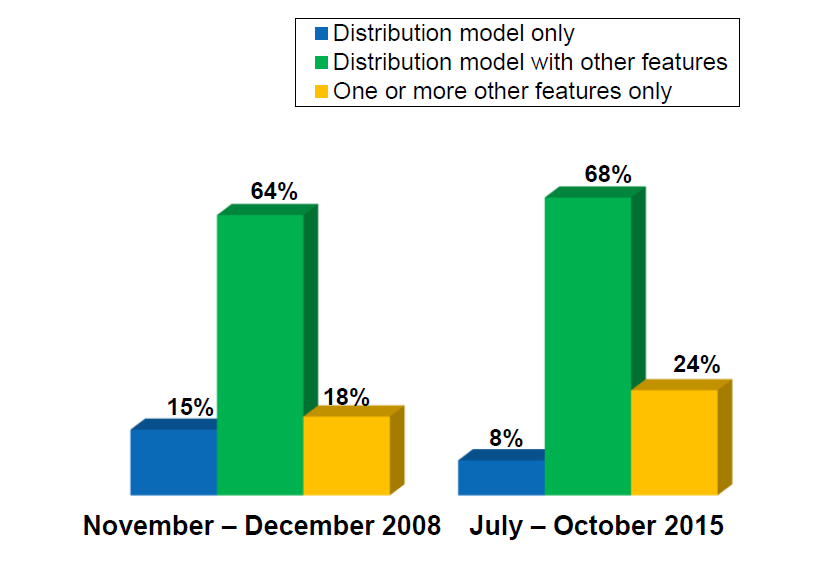
Many general education programs have been built around distribution requirements. And the AAC&U survey suggests that relatively few institutions have abandoned them. In the 2015 survey, 76 percent of colleges reported using distribution requirements, down only modestly from the 79 percent of colleges that reported using distribution requirements in a 2008 survey. But the norm — even more now than in 2008 — is a distribution requirement plus other features for general education. In fact, the share of colleges relying only on distribution requirements fell nearly in half between the two surveys.

According to the AAC&U report, colleges are building on distribution requirements by also requiring common intellectual experiences of students, thematic courses, learning communities (in which groups of students take a common sequence of courses) and other techniques.

In the survey, academic leaders were asked to indicate the design elements of their general education programs — and they could list more than one such element.

Design Elements of General Education, 2015 Survey

Element Percentage of Colleges
Distribution model 76%
Capstone or culminating studies (in majors) 60%
Upper-level general ed requirements 46%
Core curriculum 44%
Thematic required courses 42%
Common intellectual experience 41%
Capstone experience (in general ed) 26%
Learning communities 22%

The University of Nevada at Las Vegas is an example of a university keeping distribution requirements but also adding other approaches to general education. So undergraduates across fields are still required to complete courses in writing, mathematics, fine arts and humanities, social sciences, and life/physical sciences, among other categories. But UNLV has added other required elements, such as a first-year seminar, a second-year seminar and new upper-division requirements in majors, leading to a “culminating experience.”

Chris Heavey, vice provost for undergraduate education at UNLV, said the university was trying to more closely link its general education requirements to the major and to institutional learning goals. But he said it was “very challenging for most institutions to go entirely away from distribution models because the structure and resources of the institution [have] probably grown up to support those offerings.”

Debra Humphreys, senior vice president for academic planning and public engagement at AAC&U, said that “many people theoretically get that it’s not adequate” to just create categories of courses for students, and to require them to take some number of courses in each category. But she agreed with Heavey that “institutions are still organized largely by disciplinary categories that correspond to knowledge areas.” As a result, colleges “continue to chip away” at reliance on distribution requirements “but we’re still not quite there yet” in terms of moving to an entirely new model.

Humphreys is encouraged by moves like that of UNLV’s, which use distribution as a base for general education but don’t leave it there. She also said it was important that general education requirements be linked to desired learning outcomes, as the survey suggests colleges are doing.

On learning outcomes, the survey found that 85 percent of colleges report that they have a common set of desired outcomes for all undergraduates, regardless of major. That figure is up from 78 percent in the 2008 survey.

Further, of those institutions that have a common set of learning outcomes for all students, there is consensus about some of the elements that are included. The table below shows, from the 2008 survey and the 2015 survey, the share of colleges reporting that these skills and knowledge areas are part of their learning outcomes.

Common Elements of Colleges’ Learning Outcomes

Skills/Knowledge 2008 2015
Writing skills 99% 99%
Critical thinking and analytic reasoning skills 95% 98%
Quantitative reasoning skills 91% 94%
Knowledge of science 91% 92%
Knowledge of mathematics 87% 92%
Knowledge of humanities 92% 92%
Knowledge of global world cultures 87% 89%
Knowledge of social sciences 90% 89%
Knowledge of the arts n/a 85%
Oral communication skills 88% 82%
Intercultural skills and abilities 79% 79%
Information literacy skills 76% 76%
Research skills and projects 65% 75%
Ethical reasoning 75% 75%
Knowledge of diversity in the United States 73% 73%
Integration of learning across disciplines 63% 68%
Application of learning beyond the classroom 66% 65%
Civic engagement and competence 68% 63%
Knowledge of technology 61% 49%
Knowledge of languages other than English 42% 48%
Knowledge of American history 49% 47%
Knowledge of sustainability 24% 27%

Humphreys said she was pleased by one of the topics that saw the biggest increase from 2008 to now: research skills and projects. She said this was consistent with the idea of working in teams and working to solve problems — skills that employers seek and that promote cohesive learning that goes beyond one course or discipline.

Some of the scores on the list may be hard to explain. For example, the results suggest more colleges include study of a language other than English as a learning outcome. But a report from the Modern Language Association a year ago found foreign language enrollments declining, and many foreign language departments in the last few years have found themselves the target of cuts.

The high percentage (85 percent) of colleges reporting that knowledge of the arts is a learning outcome is also at odds with the relatively few colleges that require arts study for all students. Humphreys said she suspected that the high figure was due to provosts looking at requirements for arts and humanities courses and counting them as arts requirements.

Are Students Aware?

The provosts were also asked whether they believed students were aware of the desired learning outcomes at their institutions. Only 9 percent said that they believed all students understood the desired learning outcomes, and only 36 percent said that a majority of students understood them.

Humphreys said that academics should be “very worried” about these findings. She said she worried that faculty members may spend lots of time developing a general education program consistent with their institutions’ missions, launch the system with fanfare and then not do enough to promote understanding of it. That may mean that, a few years after a program launch, students may not know much about it.

The findings also point to a need for more of a focus on academic advising and for advisers to talk to students about the broad goals of general education, and not just requirements to be finished.

The completion agenda, she said, may make this more difficult. Many advisers are “under pressure to get students through as soon as possible,” she said. That is admirable, but means that students aren’t necessarily being asked about how course plans “relate to learning broadly,” but rather are encouraged to find “an efficient way to get this done.”


What Makes Test Prep Tutoring a Good Choice For Competitive Colleges?

By Melissa Burns

Every student comes to a moment in their life when they need to make a very important decision that can affect the course of their life – where they want to go to continue their education. By choosing an adequate school they can get the best education and the perfect connections that they can use in the future when they start building their career. This is definitely something that can determine the future of every individual. In case you don’t enroll to a school that you liked, you might get stuck and become depressed because you didn’t have a chance to continue your education and pursue the profession you have always wanted. Many young people can’t settle with something else and the never finish college because of that.

But, what factors determine whether you will enroll to a university that you want or not? In case you decide to consult the admissions departments of every college or university that you are interested in about this dilemma, you can rest assured that you will get a myriad of answers and some of them have nothing in common. For instance you can expect to get a lot of answers that will point out that the grades you have in high school are the most important factor while others will emphasize the benefits of practicing extracurricular activities. Some colleges value participation in community activities while others pay special attention to the things you will write in the essay as part of your application. Of course, we should not forget the impression you will leave when you finish your admissions interview.

However, many experienced people will agree that all these elements have small significance. Obviously, they can contribute to the final decision of any college, but if people are realistic they will tell you that there are two important things that matter. If you are able to handle these two things, then you can consider that you will get into college that you have always wanted. The first way to do this is to ask your father or some close relative to make a donation to the school in the form of a huge building (which is not an option for most students) and the second way is to have great score on the college entrance exam or the SAT in cases of most students. Since students need exceptional SAT scores for very competitive colleges, it is no wonder why SAT prep tutoring is a great idea.

If you want to do well on the SAT test, you use all the activities and tools you can get. There are many different options when it comes to SAT prep tutoring and the most common ones include 1-on-1 tutoring and tutoring to a group of students. Before you make your final decision you must figure out which option suits you the best. Even if you feel that you have the knowledge and experience, you will still find prep tutoring useful because it will make you more self-confident and give you a chance to test your actual knowledge.

Finding test prep teachers is not a difficult task. One of the things that you should remember is to choose prep classes in your area. Simply, use the Internet and look for such classes in your area. If you are from Santa Monica look for Santa Monica tutoring on the most popular search engines like Google, Yahoo and Bing.

You should not miss this opportunity to prepare yourself for the SAT test in an easy and convenient way. Keep in mind that this test will probably determine your future.

Melissa Burns graduated from the faculty of Journalism of Iowa State University in 2008. Nowadays she  is an entrepreneur and independent journalist. Her sphere of interests includes startups, information technologies and how these ones may be implemented. – See more at: https://collegepuzzle.stanford.edu/?p=4955#sthash.Unf28FUO.dpuf

Best Part-time Jobs For College Students

By Jane Hurst

If you are a college student, you likely need to take on a part-time job in order to be able to pay for your education, rent, etc., and to have a bit of extra cash for fun. Unfortunately, in the past the majority of part-time jobs available to college students were low paying positions in take-outs and retail stores. Luckily, times are changing, and if you are creative in your thinking, you can find all kinds of neat ways to earn extra money part time, and you will be earning a lot more than minimum wage. Here are some of our favorite ideas.

  • Circulation Clerk – Check with local and school libraries to see if they are in need of a circulation clerk. You don’t need a degree in library studies for this type of work. Your job will entail helping patrons find books, do research, find reference materials, etc. It is helpful if you have a strong background in customer service, as the job mainly involves dealing with the public.
  • Online Researcher – As a student, you are used to doing a lot of research. Why not take advantage of your research skills, and earn as much as $37 per hour. Your job will be to research questions that businesses get from their clients, and provide explanations that are easy for anyone to understand. You will need to have excellent research skills, and it helps if you are knowledgeable in certain areas of business.
  • Content Editor – This is a relatively easy job, and you can often choose your own rate of pay if you are working as a freelancer. You will be using a style guide to edit content that is going online. You will be checking for things like grammar and spelling, and be expected to offer quick turnaround times. You can earn as much as $40 per hour doing this sort of work on freelancing platforms like Upwork and Freelancer.
  • SEO Specialist – Search engine optimization helps a website to rank better in search engines like Google, Yahoo, and Bing. The higher the website ranks, more visitors and money the business has. You can get in on this by becoming a part-time SEO specialist. Your duties will involve managing SEO strategy for others, and earning up to $51 per hour. Students can work remotely for digital agencies like 80 Proof Digital, which is great if you don’t have access to transportation, or if there is not a physical location nearby to work from.
  • Guest Service Coordinator – You can earn as much as $21 per hour working as a guest service coordinator. This is a job that requires excellent customer service skills, because that will be the bulk of the work. Many industries hire people for this type of position for additional customer support, clerical support, etc.
  • Night Auditor – Hotels hire night auditors to do work that doesn’t get done during regular business hours, and to keep an eye on the reception desk. Because you will be working at night, the rate of pay is automatically going to be higher. In fact, you can earn up to $30 per hour for performing such tasks as bookkeeping, guest relations, paperwork, etc. You will be expected to have computer skills, as well as some basic knowledge of accounting.
  • Freelance Writer – Depending on the client and how good of a writer you are, you can potentially enjoy unlimited earnings as a freelance writer. In most cases, freelancers earn a minimum of $20 per hour. You need to have good writing skills, as well as grammar and spelling skills, and be able to work under deadlines. You could end up writing anything from landing pages to e-books and more.

Byline:

Jane Hurst has been working in education for over 5 years as a teacher. She loves sharing her knowledge with students, is fascinated about edtech and loves reading, a lot. Follow Jane on Twitter!


College Tuition: Good News And Bad News In Latest Trend

By

Kellie Woodhouse, Inside Higher ED

There’s good news and bad news when it comes to how much of a financial burden students and families are shouldering for a college education.

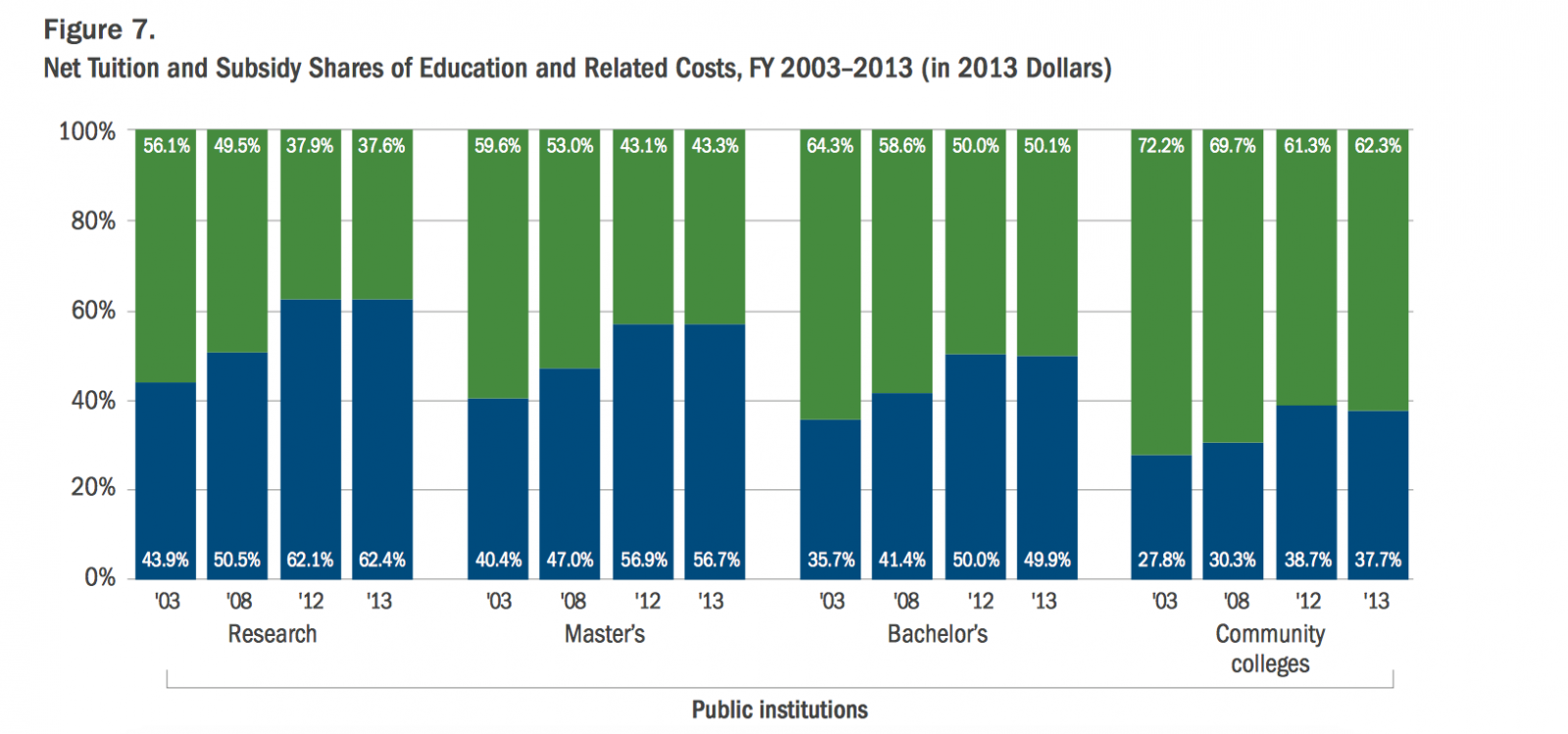
The good news? The share of tuition that covers educational costs at institutions didn’t go up much in 2013, the most recent year studied by the Delta Cost Project in its new report “Trends in College Spending: 2003-2013,” released Tuesday. The bad news? Students and families, through tuition, have been shouldering a much larger portion of educational costs ever since the recession hit in 2008. The increase is, on average, 10 percentage points.

“For the first time in a while for all public four-year institutions, the share did not go up from 2012. Community colleges actually dipped down a percentage point,” explained Steven Hurlburt, a senior researcher at American Institutes for Research and co-author of the report.

“They’re not taking on any more of the costs right now,” he said of families. Yet Hurlburt added a big caveat to the good news: not that long ago, things were much better. “Of course, we are in a period of an economic upturn. If you look at it from the beginning of the recession, they are still taking on the majority of costs.”

In 2008, net tuition at public research universities covered 50.5 percent of educational costs, on average. That figure has since ballooned to 62.4 percent in 2013, up just slightly (0.3 percent) from 2012. At public master’s institutions it was 56.7 percent (up from 47 percent in 2008) and at public bachelor’s institutions, it was 49.4 percent (up from 41.4 percent in 2008).

And at community colleges, tuition covered 37.3 percent of educational costs in 2013, up from 30.3 percent in 2008 (but down slightly from 38.3 percent in 2012).

The change in the share families pay, while slowing, is significant, Hurlburt says.

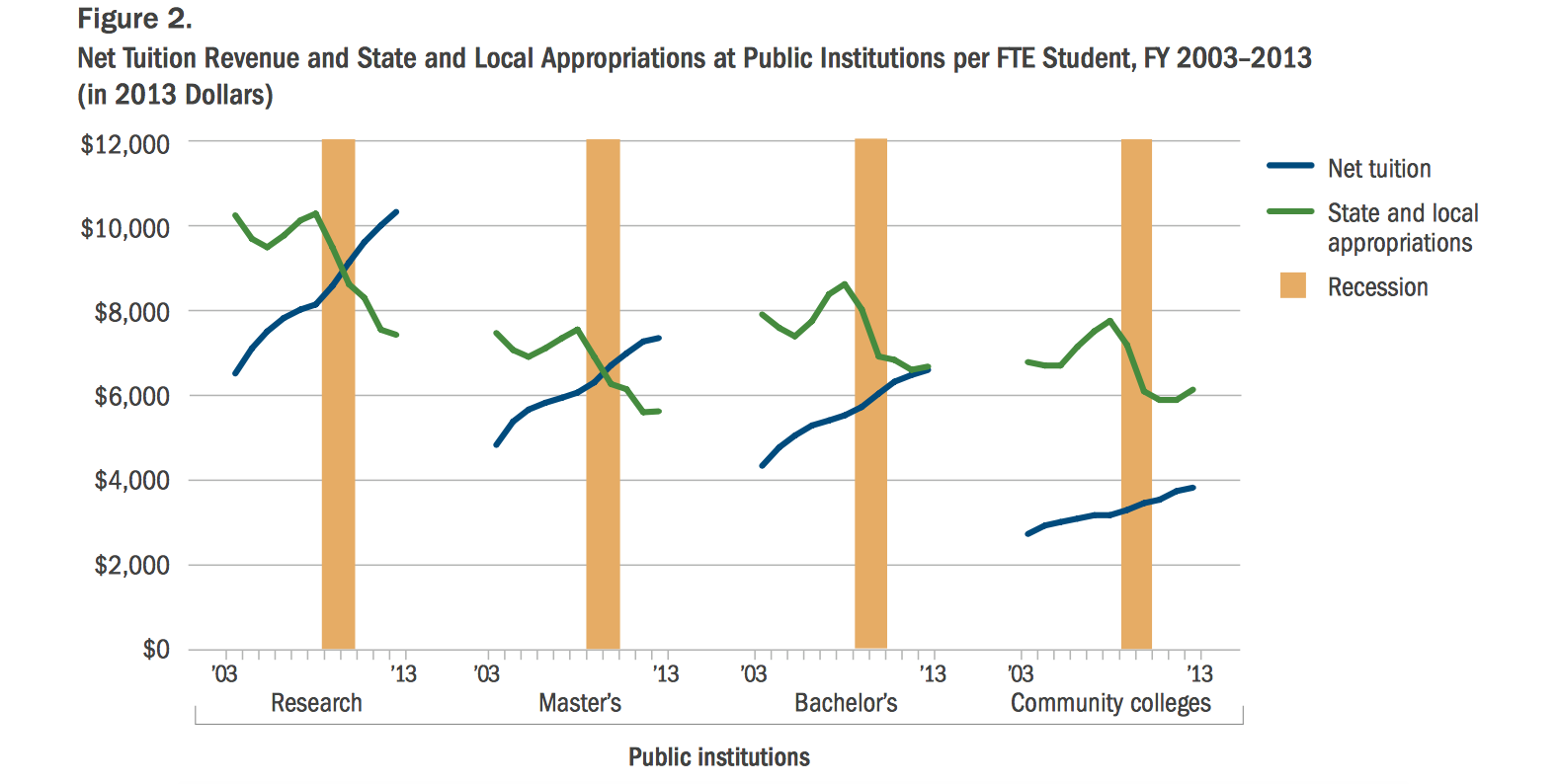
Despite the revenue constraints that colleges faced during the recession, such as lowered state and local appropriations, institutions did not drastically cut spending. Rather, they shifted more of the cost burden onto families through tuition increases. Explained the report: “Instead, they turned to students to increasingly finance their operations, further reinforcing the notion of education as a private, rather than a public, good.” And Hurlburt warns that another recession could tip the scales and make the financial burden too heavy for many students.

“What happens in the next economic downturn? Unless colleges are really going to buckle down and restructure their costs … you have this downward slide,” he said. “Our next recession we might see students and families taking on even more.”

AIR runs the Delta Cost Project, which studies spending in higher education. Its most recent report relies on the latest year of fully verified federal data, which is why it lags behind the present year.

The report also found that 2013 was the year when states began reinvesting in higher education funding after the recession, albeit slowly.

Following four years of sharp declines, state and local funding increased 5 percent for community colleges and 1 percent for public bachelor’s-granting institutions between 2012 and 2013 (although public research universities declined 2 percent, which is an improvement over annual declines since 2008). Yet funding remained well below pre-recession levels. In fact, since the recession, funding at public research universities has dipped 28 percent — or about $2,800 per student, on average — at public research universities.

Over all, 2013 was a good year for community colleges.

Not only did they see their public funding increase from 2012 to 2013, but they also increased their per-student spending by 5 percent — the second consecutive year of a significant spending increase (public four-year colleges saw per-student spending increases that averaged between 2 and 3 percent). And community colleges, for the first time since the recession, saw an uptick in revenue in 2013. The 3 percent increase in per-student revenue is likely correlated to enrollment decreases.

During the recession students flooded community colleges. Enrollment increased 25 percent between 2007 and 2011, resulting in institutions that were stretched very thin. In 2013 community college enrollment declined (4 percent) for the second consecutive year.

“Community colleges definitely were hit the hardest and they’ve seen a really good rebound,” Hurlburt said.

“They saw a large influx in the number of students enrolled [during the recession, and] because you had so many students, there are less resources to go around,” he continued. “Now there are less students. You’ve still got the same amount of resources but you don’t have to spread it around so thinly.”

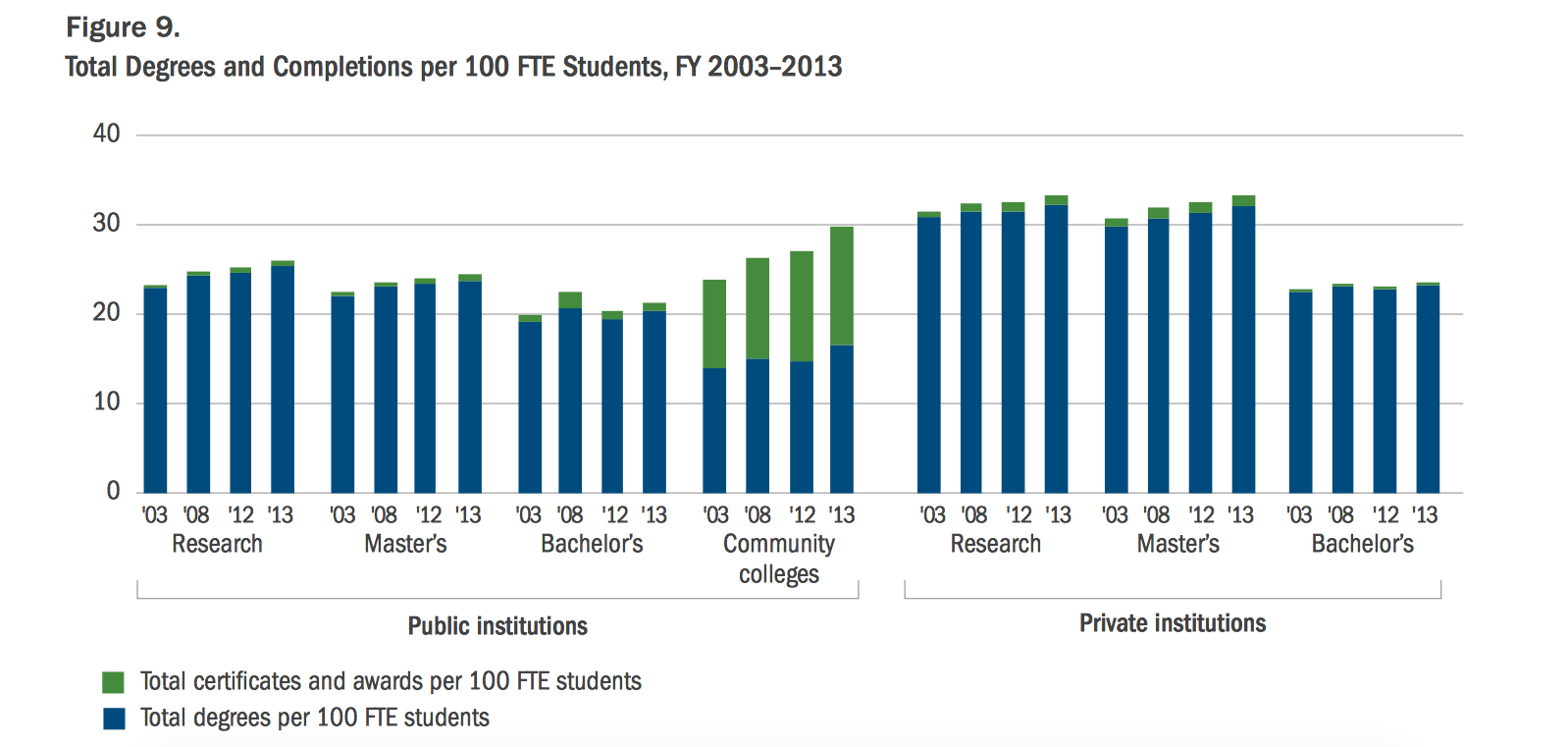
On the flip side, the increased enrollment led to a heightened degree of productivity. Community colleges, for example, awarded seven more degrees or certificates per 100 students in 2013 than they did in 2003.

Other data of note from the report:

  • From 2003 to 2013, spending on instruction and research increased 9.4 percent and 9.5 percent, respectively, at public research universities. Meanwhile, at those same institutions, spending on student services and academic support saw a much steeper increase: 22.3 percent and 25.5 percent, respectively.
  • Hurlburt surmised that increased student services spending could be the result of a heightened emphasis on career readiness or due to increased support for Pell Grant recipients since the recession.
  • Community colleges weren’t the only institutions to significantly increase the number of degrees they awarded over the decade that ended in 2013. Public institutions over all produced three more credentials per 100 students in 2013 than in 2003. Private research and master’s institutions produced two more credentials per 100 students in 2013 than in 2003.

Supporting First-Generation College Students: The Role of Traditional Counseling

Jenna lightened

By Jenna Tomasello, American Youth Policy Forum


You’re just not college material.” That was what a high school counselor told my mother after she expressed interest in going to college. Defeated, she never even applied. My mom shared this with me when I was a senior in high school and beginning to apply to colleges. At the time, I was apprehensive about applying because I could not decide on a major and I worried about enrolling as an undeclared student. I contemplated: “College is so expensive! I don’t even know what I want to do with my life! I’m only 17! But I love school.” I always loved learning and knew I wanted to continue my education, but being without a career plan seemed hasty and wasteful—until I heard my mother’s story. While her dreams of going to college were unfairly and carelessly disregarded, learning about my mother’s experience motivated me to take the leap that she never felt confident taking herself. Her story shed new light on my college-going dilemma; for my mom, my love for learning was reason enough to apply.

As a first-generation college student, my love of learning may have been enough to apply to college, but I would not have successfully enrolled and persisted through college without a great deal of supports along the way. And although my mom was always encouraging, she could offer little more than moral support without having experienced the college process herself. Fortunately, my high school counselor not only answered the questions my mother could not, but also assisted me with the college application process. She helped me sign up for the SAT and ACT, fill out the FAFSA, and submit my college applications with the appropriate documents. Most importantly, she connected me with advisors at my alma mater’s TRIO Student Support Services Program (SSSP), which led to me participate in a summer bridge program aimed at acclimating incoming college freshmen of underrepresented groups to college life and the academic workload.

While SSSP provided me with personal and academic counseling and supports, as well as additional financial assistance throughout my four years at college, the program helped me most with what some may take for granted. At monthly workshops and one-on-one check-ins with staff, I learned practical things like how to approach a professor for additional help, that FAFSA needed to be resubmitted every year, and about the urgency of registering for classes as soon as possible because they tend to fill up quickly. Looking back, this kind of advice was simple, yet so instrumental to shaping my college experience. Most influentially, my participation in SSSP led me to participating in TRIO’s McNair Scholars Program, which exposed me to thinking about graduate school for the first time and ultimately earning my master’s degree.

I firmly believe I would not be where I am today without the supports I received throughout my educational career. Unlike my mother, I was fortunate enough to have counselors, advisors, and mentors who supported me along the way. From a policy perspective, as we grapple with the role of counselors and traditional college advising in supporting the access and success of first-generation college students, the following strategies—borrowed from the College Board and reminiscent of my own experience—may be useful in framing this work moving forward.

Reach out early

Begin working with students as soon as possible, perhaps even in middle school, and encourage them to take a challenging course load, including Advanced Placement and honors courses, in order to prepare for college-level work. Additionally, help students understand their college and career options by assessing their interests and abilities and explaining what they need to do in order to get there.

Involve the family

Do not assume families are knowledgeable about college basics and try to involve them as much as possible in understanding the process so they can better support their student.

Give special attention to college search and selection

Explain the different college options student have, from community colleges to small liberal arts colleges to large research universities. Encourage students to visit colleges with their families, attend college fairs, and participate in school-lead trips to help them determine which colleges are a good fit.

Give special attention to college applications and financial aid

Help students submit their college applications and supporting materials on time and determine if they qualify for test fee waivers and/or application fee waivers. Also, assist students in filling out the FAFSA and understanding the different elements of financial aid packages, including merit and need-based scholarships, grants, subsidized and unsubsidized loans, and private loans.

Explain what college will be like

Talk with students about what to expect of the college environment, workload, and culture, and point them to various support services and social groups on campus to ensure they feel welcomed, supported, part of a community.

Collaborate with other organizations and institutions

Connect students with community groups, outreach organizations, and college programs for first-generation and other at-risk students, like SSSP and other federal TRIO programs, some of which start as early as middle school.

AYPF is starting a new body of work to explore strategies and opportunities for promoting postsecondary access and success of first-generation college students, of which traditional counseling plays a key role. Drawing again on personal anecdotes, posts 2 and 3 in this college advising series will examine the role of peers and other innovations that help students transition to and through college. Stay tuned for more to come.

Jenna Tomasello is a Program Associate at the American Youth Policy Forum.

Bright and Dark Sides of College Internet Addiction

By Melissa Burns

These days college students spend a lot of time on the Web. They like to talk with friends in social networks, they use Google instead of books. Virtual world has become a part of their daily lives as sleeping or eating. Actually there are bright and dark sides of Internet addiction but there is no distinct border which differs in healthy attitude from an illness. In this post we will try to handle the problem.

When the Web is Helpful?

The information about the diagnosis which is called Internet Addition Disorder (IAD) was published as a research and caused heated debates in the mental health community. It is hard to disagree that college students almost ‘live’ in Instagram and Facebook, and clicking links is their favorite activity, but many psychologists reject the Internet addiction as a notion. Even if a greater part of students avoids cheeting during exams they nevertheless spend a lot of time reading news about celebrities, playing online games and uploading photos into their accounts in social media. All of this distracts students from study time.

Positive reasons for constant online activity include:


  • possibility to complete homework easily using popular applications and software, for instance on devcompanies.com;
  • a chance to find the latest updates of needed applications;
  • place to read any information for studies as well as download books and textbooks;
  • capability to discuss up-to-date issues on forums;
  • way to communicate with classmates and instructors;
  • opportunity to research job opportunities.

If a young person has some problems with social interaction, he or she can communicate with people online because it is important for mental health. Moreover, the Web is a tool which provides opportunities to study and work online and get knowledge to succeed in your professional life.

How to Prevent IAD?

Here are some tips which can be helpful in healthy Web usage:


  1. Try to notice warning signs in time. If you realize that you spend more time communicating in Facebook than making your homework, it is time to remake your schedule.
  2. Spend more time away from your computer. It’s an obsession to refresh your MySpace page every minute, so if you find out that you do that, just close your laptop and make a break.
  3. Give yourself a chance for a ‘face time.’ Meet people in person instead of talking to them online. It is not healthy to rely only on virtual communication. In real life you can meet good people which might play important role in your future.

Preventive measures are always better than getting rid of the consequences. If you understand that you can’t fight Internet Addiction alone and this influences your studies badly, ask your friend or relative help you solve this problem.  If you notice your addiction in time you will be able to prevent it without any bad consequences such as social isolation, depression and many other unpleasant symptoms. Of course, the Web is helpful in many situations but it should not replace real activities and must not obstruct your happiness in your real collegial, professional, and personal life.

Can Technology Help Replace College Counselors And Mentors

By Jennifer Brown, American Youth Policy Forum

The Get Schooled Foundation recently published a review of almost 200 college admissions technology applications and evaluated their effectiveness in helping low-income students with college admissions. Of the key findings in the report, this one stuck with me: “There is no ‘go-to’ site that incorporates all the different milestones necessary to help students prepare for and complete the college application process.” So, evidently, technology can’t do it all, but it was clear from their extensive review of online tools and my own experience with some of these sites that online sources can be great sources of information. Yet, they simply aren’t enough to replace the people involved in the college application and admissions process who often support a student every step of the way.

Ironically, many of these sites point students in the direction of individuals who can answer their questions. Here’s some advice from one site:

How to apply. Your school guidance counselor can help you, including how to file a Free Application for Federal Student Aid (FAFSA), which makes you a candidate for all federal student aid.

It is clear that technology can be a valuable source of information for incoming and aspiring college students, but cannot replace the counseling and peer relationships that my colleagues profiled in their previous posts. These personal relationships and human expertise are essential in ensuring that college is accessible to first-generation students.

Online Advising in College

Once enrolled and on campus, all students face an onslaught of new experiences and the challenge of navigating a new environment. As mentioned in previous posts, first-generation college students often do not have the resources within their family network to make sense of all the information coming their way. Here again there is an opportunity for technology to play a role in helping students make sense of the mountain of information, specifically around course selection and scheduling.

Often called the “Netflix of advising,” Degree Compass, a course recommendation system developed at Austin Peay State University in Tennessee, successfully recommends courses that best fit students’ talents and programs of study for upcoming semesters. Utilizing predictive analytic techniques similar to movie recommendations that Netflix makes based on your preferences, these recommendations are based on grade and enrollment data to rank courses according to factors that measure how well each course might help the student progress through his or her program. Coupled with some student-generated data such as expected major, the program strongly recommends a course which is necessary for a student to graduate, core to the university curriculum and their major, and in which the student is expected to succeed academically. The results from this online advising system have been quite impressive, especially with Pell grant recipients.According to Austin Peay’s own analysis, a comparison of student grades before the introduction of the system with those today show a steadily increasing proportion of passing grades so that results in the fall of 2012 were almost 5 standard deviations better than those in the fall of 2010. Although Degree Compass is helping students better navigate courses to get to graduation, a student is still required to meet with an actual advisor in order to receive official permission to graduate.

Similarly, Arizona State’s eAdvisor puts the information students need about required courses within a major and their progress towards graduation online and monitors their progress with updates via the system. Yet, here again technology cannot replace the relationship with an advisor, for if a student does get off track, they cannot register for additional classes until they meet and get approval from their advisor.

Again, we see data and technology playing an integral role in helping students navigate the complex systems required to get to and through college, especially for those students who are first generation, but it is clear that personal relationships still play a necessary role. Although technology has enabled us to get information faster and more reliably into the hands of students, it appears that it is most effective when paired with traditional in-person counseling and advising.

And, just in case you were wondering, I haven’t fully given up on reading the actual print newspaper. I still get the weekend paper delivered to my home and would never pass up an opportunity to read the Comics and get my hands dirty with the colored ink!

Jennifer Brown Lerner is Deputy Director at the American Youth Policy Forum.