
Peer Mentors Help College Students Succeed
Carinne Deeds, American Youth Policy Forum
As the first in my family to go to college, I entered the application process with an endless amount of questions. Where should I go to college? Can I even get into college? Where do I find all the necessary forms? What in the world is a FAFSA? Thanks to helpful college counselors at my high school (and after a very long and confusing year of figuring things out by trial and error), I was able to navigate the complicated processes required to get into college. What proved to be even more of a challenge, however, was overcoming my anxieties about actually being a college student before and even after I arrived on campus. What will college life be like? Where should I live? Will I have time for a social life if I also have to work? How and where can I make friends? Will I miss my family? What if I get lonely? What if I’m not cut out for this?
Like many first-generation students, my parents, though they loved and supported me and would have done anything they could to help, were unfamiliar with the complicated processes required to get to and persist through college, as well as the personal skills and resources necessary to not only survive but to thrive as an individual newly embarking into the adult world. Additionally, most of my anxiety about fitting in and being comfortable as a college student could neither be addressed by my parents, nor a high school guidance counselor, nor a university online FAQ page.
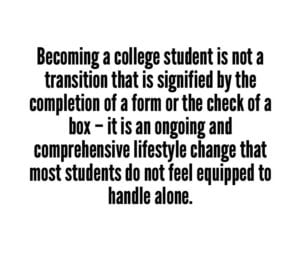 I was fortunate to attend a university that recognized the need students have to receive support outside of the classroom and even beyond traditional college advising. Thanks in large part to peers and mentors I encountered through various university systems and programs, I slowly but surely transitioned from college-aspiring Carinne to college-attending Carinne – a transition that changed the course of my life.
The role of peer advising
Peer mentors* have the ability to connect with students in a way that traditional advisors cannot, either while they’re in high school, in transition, or have already made it to campus. Aside from providing additional guidance on logistical issues like form submission and tuition deadlines, peers have a significant amount of flexibility in terms of both the time and the topic of communication. For example, peer advisors can often maintain regular and ongoing contact with their mentees without being constrained by more formal requirements. Additionally, questions of school culture, community, belonging, and even some questions about navigating university systems are usually questions that students either cannot or do not feel comfortable asking traditional academic advisors. Peers may be more willing and able to help students with more personal concerns such as homesickness, social issues, or academic and personal insecurities, and may also have a deeper level of empathy and understanding of these issues, as they have likely encountered similar experiences themselves.
Research evidence affirms the idea that peer supports are crucial in helping students succeed in college, and that many peer mentoring programs have had positive effects on both mentors and mentees. According to theJournal of College Reading and Learning, mentoring programs can improve the interpersonal, communication, and leadership skills of mentors. Both mentees and mentors can acquire better time management skills and a greater sense of responsibility. The mentees themselves receive many additional benefits, such as self-esteem, goal-setting, and career guidance. Research also indicates that peer mentoring programs can have a positive effect on academic outcomes for mentees.
What does peer advising look like?
The term peer advising generally refers to the traditional one-on-one method of advising, in which an older peer (usually a current or former college student) provides support to a future or current college student – preferably from a similar background as the mentor. It also describes those situations in which current college students can connect with other students in the same or a similar stage of the process. For example, learning communities such as those at CUNY provide current students with a network of peers in a smaller, more personalized setting. Students take classes together, study together, and also have access to counselors, tutors, and other support services. These programs capitalize on the idea that students going through a common experience may be ideally suited to support one another, in addition to receiving supports from caring adults. Peer advising also occurs in a variety of forms at the individual level. As mentioned in a previous blog post, the Urban Assembly’s (UA) Bridge to College Program in New York hires and trains alumni to provide counseling to students with regards to the financial, personal, and logistical difficulties faced during the college transition.
This element of providing a personal connection, whether it be in a one-on-one or a group setting, is a unique benefit of peer mentoring programs and is likely one reason they have been shown to be so effective. As I reflect on my own experience as a first-generation college student, I recognize that without the support I received from my peer mentors and the personal connection I felt to the university because of them, my college experience could have ended much differently.
Employers Want More Than Degrees
When a Degree Is Just the Beginning
Today’s employers want more, say providers of alternative credentials
By Goldie Blumenstyk , Chronicle Of Higher Education
The idea of students graduating from college with just a diploma — a single academic credential — could soon seem downright quaint.
At some institutions, it already is. Community colleges in North Carolina encourage students to complete coursework while earning certifications from industry groups like the National Institute for Metalworking Skills and the National Aviation Consortium. At Lipscomb University, students can qualify for badges, endorsed by outside experts, to prove they have mastered skills such as “Active Listening” and “Drive and Energy.” Students at Elon University get an “extended transcript” describing their nonacademic accomplishments.
Higher education is entering a new era, one in which some industry and nonacademic certifications are more valuable than degrees, transcripts are becoming credentials in their own right, and colleges are using badges to offer assurances to employers about students’ abilities in ways that a degree no longer seems to do. On top of the traditional academic and corporate players, a whole bunch of nonprofits and businesses are also jumping on — if not leading — the movement, including MOOC providers like Coursera and Udacity and so-called coding academies like General Assembly, Galvanize, and the Flatiron School.
Related Content
- A Gallery of Credentials
The explosion in credentials is upending long-held notions about the value of a college degree. Many of these credentials are in digital formats that can be easily shared among students, educators, and employers in new kinds of e-portfolios or on commercial sites like LinkedIn. “The reason we’re so excited about them is that they contain claims and evidence,” says Daniel T. Hickey, an associate professor of education at Indiana University at Bloomington and an advocate of badges and other new forms of verifiable credentials. “What people don’t understand is: That is a game changer.”
It’s also a development laced with confusion. Among colleges, companies, and many other organizations, thousands of bodies now issue postsecondary credentials, in a variety of forms.
As Jamie P. Merisotis, president of the Lumina Foundation, has said, that has left a highly fragmented landscape with no system in place to assure the quality of those credentials. (That is a particular problem for the foundation; its “Goal 2025” is to increase the proportion of Americans who have earned “high-quality” degrees, certificates, and other credentials to 60 percent over the next decade, but it needs to know which ones to count.)
- As students flock to these new providers, investors, too, are taking notice. For those who might once have been captivated by the B.A.s and M.A.s awarded by for-profit colleges, “the trend is to get away from letters,” says Susan Wolford, a managing director with BMO Capital Markets. Companies involved with lifelong learning and “credentializing” are favorite targets for the mergers-and-acquisitions crowd, she says. That includes not just those trendy coding boot camps and MOOCs but also companies that offer training in sales skills or the energy field. Whether it’s a company that gives a credential or merely one that “brands the knowledge” it is offering, she says, “people are very mesmerized by the idea.”
The explosion in credentials is upending long-held notions about the value of a college degree.
In June, Lumina announced a campaign to make greater sense of the evolving practices and policies around the cornucopia of credentials. The campaign echoes the foundation’s Degree Qualifications Profile work, a project aimed at creating common reference points to define the intellectual skills associated with associate, bachelor’s, and master’s degrees.
The new effort includes grants to groups at universities and a nonprofit organization that are trying to create a “credential registry” for students and employers, and to develop a taxonomical framework to help categorize which credentials reflect what skills. Lumina has also called for a “national conversation” on credentials, to take place in part at a conference in Washington in October. Policy makers and academics will discuss ways to make the fragmented credential system more navigable. The foundation seems to have struck a nerve: About 80 associations, companies, and organizations have signed on as co-sponsors of its campaign.
With an education ecosystem that is increasingly featuring “lots of on- and off-ramps,” says Holly Zanville, the Lumina official heading its credentials project, “we’re going to need some better structures than we have now.”
Several forces are behind the newfound attention to credentials. One is the general interest in badges, which arose in online gaming and spread to higher education as more colleges began using digital portfolios. Another factor is higher education’s recent fascination with competency-based education, which, lacking the structure of courses, is well suited to use badges to determine how certain skills are defined and assessed.
An even more powerful force behind the credentials trend, however, is the so-called skills gap, or the apparent mismatch between the skills employers say they want in job candidates and what they see — or can’t see — in recent college graduates. Couple that with concerns about the cost of college and its return on investment, and what’s left, say observers, is a general unease about the value of a degree and what it signals to potential employers. “It’s unclear how great a signal it was before,” says Michael B. Horn, co-founder and executive director for education of the Clayton Christensen Institute for Disruptive Innovation, which studies innovation in education. Now the picture is even cloudier.
But at this stage, so is the picture for new kinds of credentials, he adds. The crucial factor that will determine the success of these new credentials, he says, is the assessment underlying them, and there, “the thinking about it still seems fluffy.”
“You have to be loyal to your skills. You have to build a skill portfolio you can sell.”
Still, shifts in the job market have lent greater importance to credentials. “It’s the real change in the economy, which requires upskilling,” says Anthony P. Carnevale, director of the Center on Education and the Workforce at Georgetown University. But he warns that the value applies only to good credentials, which he, as an economist, defines as those that bring added earnings. And with people changing jobs more often, potential employees are recognizing that they need good credentials to get in the door and advance in their careers. Forget loyalty to your employer, says Mr. Carnevale: “You have to be loyal to your skills. You have to build a skill portfolio you can sell.”
The underlying ethos of the credentials movement — that “it’s all about the job” — may make many four-year colleges and even some community colleges uncomfortable. But that hasn’t kept several of them from experimenting with new types of credentials — in many cases aided by a burgeoning group of young companies like Pathbrite, Fidelis Education, and Parchment, which sell digital products that help students manage and communicate their skills and expertise. Gunnar Counselman, a founder of Fidelis, which also offers tools that colleges can use to build assessments that underlie their badges, says that until recently, his company’s services were a hard sell: “Five years ago, nobody believed the degree was insufficient.” Today, he says, more college officials are starting to say that degrees are necessary, but not enough.
“The whole skills gap,” says Mr. Counselman, “is the result of schools’ not understanding what employers need” and not creating the kind of curriculum modules that would translate to the workplace. Changing attitudes are fueled by frustration with the status quo. You go to school for 16 years, he points out, “and you get four freaking data points out of it”: the name of the college, the name of the degree, the year it was issued, and maybe a GPA.
Lipscomb University, which is working with Fidelis, hopes to fill the information gap with badges that describe the “soft” skills its students have acquired, like communicating effectively and working in teams. Colleges tell students they’re getting training for life, but “we didn’t ever have any way of verifying that or quantifying that,” says Nina J. Morel, dean of the College of Professional Studies there. The badge program is “something more concrete,” she says.
Lipscomb, in Tennessee, has developed 41 badges based on employment-screening techniques developed by Polaris Assessment Systems. The badges will be digital elements of a competency transcript, she says, and can be added to students’ LinkedIn accounts and online portfolios.
It could be a long time before employers start demanding such evidence from graduates, acknowledges Ms. Morel, but “we want to make sure they have every opportunity and every tool in their tool box to convince an employer.”
In fact, for most employers, the college degree remains the key credential, so much so that a 2014 report by Burning Glass, a company that analyzes job ads, found that employers in many fields were requiring bachelor’s degrees for jobs that previously didn’t need them. (The exceptions were for fields, such as health care, in which there are good alternatives for identifying skill proficiency.)
But that may be changing. Recently. Burning Glass analyzed 20.6 million non-health-care job ads from a 12-month period, and it found that 20 percent of all posts requiring a bachelor’s degree also called for applicants to have a certificate or a license for a particular skill. That, says Matthew Sigelman, the company’s chief executive, suggests that employers see the college degree “as a minimum ticket to ride rather than something validating specific competencies.”
Burning Glass hasn’t seen much interest from employers in badges, at least not yet. “That doesn’t mean they don’t have value,” says Mr. Sigelman. But they’ll need to be externally validated, or carry their own brand, if they’re going to matter.
Certificates themselves are not all equal, either. Of the 20.6 million jobs analyzed, Burning Glass found 2.8 million requiring a certificate. But only certain certificates were highly sought. Of the thousands of possible certificates, the same 200 came up again and again. The Project Management Professional (PMP) and Certified Information Systems Security Professional (CISSP) credentials were among those that topped the list.
Those trends have not been lost on the North Carolina Community College system, which has been refashioning its curricula around more short-term, work-force-ready programs. Often, “industry credentials mean more to employers than the academic degree,” notes R. Scott Ralls, departing president of the system. That’s the reason, he says, that when his system’s colleges reconfigured 89 degree programs and collapsed them into 31, they took pains to build those programs so that most of them incorporated industry-certified credentials as steppingstones to the degree. When possible, the colleges prefer to use recognized, existing credentials rather than create new ones, says Mr. Ralls, who will become president of Northern Virginia Community College this month. “It’s about portability.”
But for subjects and fields that are not so easily certified, some experts predict that a proliferation of badges and expanded transcripts will occur, which means a lot more chaos before there is much cohesion.
“Badges without taxonomies, without some shared understanding, without rubrics, are meaningless,” notes Matthew Pittinsky, an assistant research professor in the school of social and family dynamics at Arizona State University and founder of Parchment, a credentials-management company.
But he argues that a system with richer credentials is ultimately a better alternative than one in which the “iron logic of the labor market starts to prescribe the makeup of the bachelor’s degree in a way that most academics would not be comfortable with.”
Reverse Transfer Awards Associate Degrees Retroactively
|
The Most Useful Apple iPhone and iPad Apps for Students
By Melissa Burns
All responsible students always try to stay on top of useful things for college and treat their studies very seriously. If you use iPhone or iPad you can choose from a large variety of useful applications which are sure to help you study harder, tackle necessary assignments, organize your time better than ever. So let us see what applications are the most appropriate for modern students and note a few ones which are worth using.
Apps for Data Collecting
If you spend much time in college preparing presentations, writing papers or looking for required data, it would be much comfortable to keep all this information in the Cloud. Apple offers a number of apps allowing to keep all papers, spreadsheets and other documents in sync, and access them easily from any place. Moreover, all papers are kept in one place and it’s no matter what device you use. You can share your documents in .doc, .xls, and a few other formats with PC users and they can work with these documents as well.
Apps for Class Material Downloading
Apple offers several applications which allow you to download lectures and other class materials right to your iPhone or iPad. In addition, there is a study tool which can save gigabytes of videos, and other types of material by topic you are learning. If you don’t want to ‘grab’ new lessons by yourself, you can sign up for automatic downloading of necessary courses.
Scheduling Apps
It is really important to have a task app to make to-do lists for a day or a week in advance. Apple has a few special applications for students always to be ready for exams, paper works etc. To add a task you should just install an app and throw it to your inbox. You can very easily create personal lists, notes, and other tasks. If you make a group project you are able to share lists and get special notifications when the tasks are updated or when the new ones are added or completed.
Apps for Calculation
Whether you are a programmer or a computer engineer the Apple calculation apps are indispensable. These programs support all variants of scientific notation, conversions, and boast many more functions. These apps will be really useful for you even after graduation.
Apps for Making Notes
When you attend to lectures you can use special apps to make notes. Apple applications for iPhone and iPad support tags and separate notebooks, allow you to make photos of a blackboard, and tag them for definite courses. iCloud sync is a great advantage so you can store your files in a cloud and access them whenever you wish from different devices.
New Mac and iOs owners can use most of the apps free of charge. For some older devices the programs can be purchased for very optimal prices. Find all apps here. You can choose such applications for iPhone and iPad as Pages and Numbers for data collecting, iTunes for downloading class materials, Wunderlist for scheduling, PCalc for calculations, and so on.
Melissa Burns graduated from the faculty of Journalism of Iowa State University in 2008. Nowadays she is an entrepreneur and independent journalist. Her sphere of interests includes startups, information technologies and how these ones may be implemented.
– See more at: https://collegepuzzle.stanford.edu/?p=4971#sthash.gsehrThT.dpuf
Rich And Poor Paths To College Diverge Even More
Rich-poor divide grows on college campuses
Rich and poor students take paths to college that are even more dramatically divergent than in the past, new data show. (Hechinger Report, Dec. 17)
How To Increase Participation and Success In Dual Enrollment High School/ College Programs
ACT Using Dual Enrollment to Improve the Educational Outcomes of High School Students This report offers key recommendations and analysis on how to effectively increase student participation and success in dual enrollment programs. It is the first in a series of steps ACT will take as part of its multiyear commitment to boost the number of students taking dual enrollment courses across the nation.
Math Demands For College Prep Not Justified
Mathematics
How much do college-bound students need?
Some are saying the math skills now demanded of many high school students are simply harder than they need to be, even for the majority of college-bound students. (Deseret News, Dec. 13)
It Is Time To Rethink The Senior Year In High School
This is the subtitle of my post today and more descriptive of what is in the JFF report
Co-authors Joel Vargas of JFF and Andrea Venezia of the Education Insights Center outline the principles of co-design, co-delivery, and co-validation that must guide new partnerships between high school and postsecondary systems to raise college readiness and success. The paper frames how educators can build upon momentum to increase collective responsibility and solutions across systems. It provides a framework that can be used to guide evidence-based experimentation within and across K-12 and postsecondary education systems. It also describes the practices of exemplary partnerships around the country and suggests policies to promote the development of more partnerships that can spread this innovative work.
Better Road Map For Effective High School College Partnerships
Co-authors Joel Vargas of JFF and Andrea Venezia of the Education Insights Center outline the principles of co-design, co-delivery, and co-validation that must guide new partnerships between high school and postsecondary systems to raise college readiness and success. The paper frames how educators can build upon momentum to increase collective responsibility and solutions across systems. It provides a framework that can be used to guide evidence-based experimentation within and across K-12 and postsecondary education systems. It also describes the practices of exemplary partnerships around the country and suggests policies to promote the development of more partnerships that can spread this innovative work.
Better Transfer System Crucial For College Completion
By
Paul Fain-Inside Higher Ed
The national college completion push has stalled, with graduation rates now going the wrong direction. Perhaps the best way to turn the tide, a new coalition argues, is to fix the inefficient and often neglected transfer pipeline from community colleges to four-year institutions.
“We’ve got to have much more urgency around this issue,” said Josh Wyner, vice president and executive director of the Aspen Institute’s College Excellence Program. “There’s room for improvement on both sides.”
Aspen has teamed up with the Community College Research Center at Columbia University’s Teachers College and Public Agenda on a project to prod states and colleges to do a better job on transfer.
To kick off the campaign, the groups plan to release a report next month from CCRC and the National Student Clearinghouse Research Center that will expose the contours of the problem. It won’t paint a pretty picture.
For example, the groups say the leaky transfer pipeline contributes to higher education’s equity gap, which is growing. That’s because research shows community college students who transfer to four-year institutions are more likely to be from low-income backgrounds than are their peers who first enroll in bachelor’s degree programs, even at nonselective colleges.
And while 80 percent of community college students say they eventually want to earn a bachelor’s degree, few ever do.
New completion data from the clearinghouse, released last month, found that just 38 percent of students who first enrolled at a community college earned a degree (associate or bachelor’s) within six years. And that rate is declining — down one percentage point from last year.
“The transfer system is inefficient. It’s very confusing to students,” said Davis Jenkins, a senior research associate at CCRC.
Public Agenda conducted focus groups in Indiana last year to see how the transfer process has worked for 333 students from eight Indiana University campuses and eight Ivy Tech Community College campuses.
Most of the students told stories about how they experience college as a maze, rather than as a clear pathway, according to a report Public Agenda released about the focus groups. Many said courses they took at Ivy Tech, which is the statewide community college system, did not transfer to Indiana, or that transfer credits did not count toward their majors.
“Only 11 of the 25 courses I took transferred,” said a student at Indiana. “And of the classes that transferred, not all of them transferred for my degree. I lost so much time and money.”
Likewise, students often described the college advising system as being unhelpful or even misleading about the transfer process. And students said they received inconsistent and confusing information about how to make the jump.
“The [Indiana University]/Ivy Tech relationship is kind of like a three-legged race,” a student at Indiana said. “They’re really bound together in a way that is undeniable, but they’re not in sync. It’s very difficult, I think, on both sides.”
Outliers and Exemplars
Indiana and Ivy Tech are hardly the only institutions to struggle with coordination on transfer. In fact, the Public Agenda report describes how the flagship university’s regional campuses have made strides to improve their transfer relationship with Ivy Tech. And the problems that remain in Indiana are common at many institutions around the country, Jenkins said.
For example, he said many regional four-year universities do not hold new student orientations for transfer students from community colleges. And that’s despite evidence the low-cost orientations can make a big difference for students.
“The colleges aren’t doing all the things they know that work for incoming freshmen,” said Wyner.
A significant driver of the problem, according to Jenkins, is the ambition and mission creep that infects many regional four-year universities and often leads to neglect of transfer students, who make up fully one-third of the sector’s new students.
“They think they’re Harvard and don’t realize the world has changed,” he said.
Even so, there are outliers. CCRC and Aspen have seen wide variation in the retention and graduation rates of transfer students at four-year universities. The forthcoming report will break down those differences at the state level, following 1.2 million community college students who first enrolled in 2007 to see how many transferred and earned a bachelor’s degree.
The data in the report will be sliced and diced in some novel ways. For example, it will show how lower-income students fare in comparison to their wealthier peers when it comes to transfer (not good).
Aspen has observed some of the best transfer relationships in the country firsthand, as part of the group’s vetting of candidates for its prize for community college excellence. Wyner said some of the winners, such as California’s Santa Barbara City College or Florida’s Valencia College and Santa Fe College, have been successful with the bachelor’s degree attainment rates of their former students.
For that to happen, however, Wyner said the two-year colleges need to closely collaborate with nearby public universities. That certainly has been the case for Valencia’s transfer partner, the University of Central Florida, which guarantees admission to Valencia graduates. About 30 percent of Valencia students transfer to a four-year institution, with 80 percent of those transfers going to UCF.
“Those who enter Valencia with their sights on UCF get counseling all along from both schools,” Aspen said in its 2011 write-up of Valencia as the first winner of the prize. “Representatives from the community college and from the university work together to analyze student data and align programs.”
As part of the new project, Aspen plans to release a playbook on what works in transfer partnerships. And the group will begin to focus in part on four-year institutions, which is a shift.
“This is relevant to the entire spectrum of four-year colleges,” Wyner said. “We’re starting to engage the four-year sector. And transfer is the natural place to start.”
The timing is right, in part because of the spread of performance-funding formulas (at least 33 states have those formulas in place) and the financial pressures most public colleges are facing, said both Wyner and Jenkins. As a result, many public universities need transfer students to boost their enrollment numbers — not to mention the tuition dollars those students bring. And four-year institutions need transfer students to stick around and graduate to avoid being dinged on funding formulas.
One goal of the project, Wyner said, is to change the way college completion is viewed. So far, related metrics and accountability measures are based on graduation and transfer rates of individual colleges. What happens to students after they leave an institution, however, often is not well understood.
“We now need to move to that next step,” Wyner said, “where multiple institutions own the awarding of a credential. That’s a much harder thing to do.”

Archives (Old)
Blogroll
Education Blogs
Educational Resources & Organizations
- Achieve
- Alliance for Excellent Education
- Aspen Institute
- Center for Enrollment Research, Policy, and Practice
- Center on Education Policy
- Education Commission of the States
- Educational Policy Improvement Center
- National Center for Postsecondary Research
- National Center on Education and the Economy
- National Center on Public Policy and Higher Education
- The Education Trust
- United States Department of Education
- WestEd
